Stop Fixing AI Outputs. Start Building Smarter Workflows
A practical playbook to save hours and future‑proof your career

A practical playbook to save hours and future‑proof your career
Download upon purchase
You've typed the prompt. You hit enter. You got the answer. And now you're spending the next forty-five minutes fixing it.
Sound familiar?
I watched a subject-matter expert spend two weeks on a project that should have taken two days. She was using AI. She was working hard. But she was stuck on the "AI Treadmill"—generating, editing, regenerating, editing again. Her outputs were generic. Her workflows were fragile. She wasn't building assets; she was clearing tasks.
Here's the hard truth: Prompt engineering is dead. Long live prompt architecture.
If you're still treating AI like a search bar, you're leaving value on the table. You're working harder than you need to. And honestly? You're at risk of being replaced by someone who knows how to direct the tool, not just use it.
This book isn't about collecting clever prompts. It's about building a system that works when you're tired, when the stakes are high, and when "good enough" isn't an option.
Most professionals I coach in Singapore face the same wall. They know AI matters. They've tried the chatbots. But they haven't integrated AI into their work in a way that sticks.
Why? Because they're focusing on the what (the output) instead of the how (the workflow).
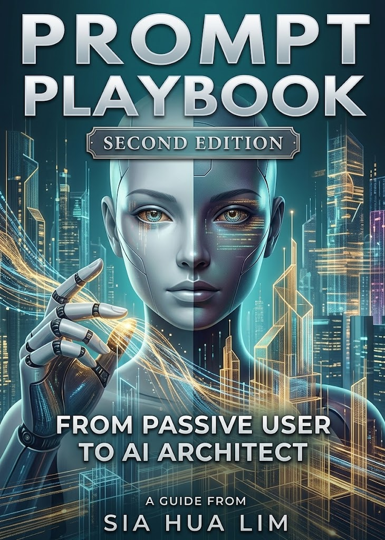
Prompt Playbook: From Passive User to AI Architect is a practical guide for busy professionals who want results, not hype. I've stripped away the jargon. I've tested every framework with real teams. Here's what you get:
1. The ACPR Framework
This is the backbone of the book. It's a fill-in-the-blank system that turns vague thoughts into precise instructions. You'll learn how to stop guessing and start directing.
2. Advanced Prompting Techniques
Once you have the base, we level up. You'll learn:
3. Strategic Asset Creation
Don't just finish tasks. Build assets. The ARIS Framework teaches you to generate professional assets from a single task. The Departmental Content Transformer shows you how to turn one announcement into a full communication campaign.
4. Ethics, Security, and Future-Proofing
AI carries risk. Data privacy matters. Hallucinations happen. You'll learn how to use these tools responsibly, protect your client data, and prepare for the agentic future without losing your human edge.
I wrote this for the intelligent but busy reader. You might be:
If you're looking for a magic button, this isn't it. If you're looking for a reliable workflow, you're in the right place.
I don't work in a tech lab. I work with real people in real workplaces.
My mission is simple: Technology should empower people rather than intimidate them.
I've seen the anxiety. I've seen the confusion. And I've seen the breakthrough when someone finally clicks with a tool that fits their workflow. I don't promise overnight transformation. I offer a path: start where you are, use what you have, improve what you can.
I believe sustainable habits beat novelty every time. That's why this book focuses on repeatable methods, not chasing every new tool that hits the market. I want you to feel capable, not overwhelmed.
Here's something most book sales pages won't tell you: This won't work if you don't do the work. You can buy the book. You can read the frameworks. But if you don't apply them, nothing changes. I'm not here to sell you a dream. I'm here to give you the tools. You have to pick them up.
I also disagree with some of the hype out there. I don't think AI will replace everyone. I think it will replace everyone who doesn't use AI effectively. There's a difference. One is fear-mongering. The other is a call to action.
The future of work isn't a distant speculation. It's unfolding now. Agentic workflows, hyper-automation, and customized apps are already changing how work gets done.
You have two choices.
You can keep typing prompts into a chat box and hoping for the best. You can keep editing generic outputs late at night. You can wonder if your skills are still relevant.
Or you can build the system.
You can learn to direct AI with clarity. You can create assets that save you hours every week. You can position yourself as the leader who knows how to use these tools responsibly.
Technology should empower you. It shouldn't intimidate you. But empowerment requires action.